Dr. Napoleon Chagnon, the man whose research and writings really put the Yanomamö on the map (in Western eyes), has recently released a new book. I have not yet read it, but he’s been making the rounds of the media and has been getting a lot of press.
Interestingly, at the same time he has been feted in some media (I did hear the NPR interview) a chorus of voices has also been raised against his views. He rose to fame by attacking the popular view of indigenous peoples at the time he was first researching. That view, of the ‘noble savage’ who lived in perfect harmony with nature and their communities was at odds with what Chagnon ‘discovered’ in his research among the Yanomamö. His observation was that the Yanomamö were incredibly violent. Life expectancy for males was short. Intertribal warfare was common. And Chagnon said it was all competition for women. Basically, evolutionary competition for breeding drove the violence. Of course, his conclusions were met with resistance. Other scandals engulfed the anthropology world, especially related to the Yanomamö of Venezuela and Brazil. Depending on who you talk to, Chagnon is a brave genius or a despicable character.
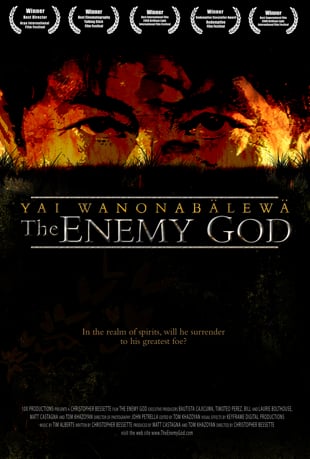
I am not an anthropologist, but to borrow a phrase, someone has to speak for the Yanomamö. The Brazilian Yanomamö have a strong spokesman in Davi Kopenawa Yanomami and he has some unflattering things to say about Chagnon and his ideas. But our friends in Venezuela don’t have such a voice. Bautista Cajicuwa, a former shaman and headman in his community in Amazonas Province, has a few things to say about his people and their traditions and lives. I won’t attempt to speak for him. He asked for this film to be made to tell their story. It is his story; their story.
Violence, yes. Over women, perhaps. But what about the spiritual traditions that inform all of Yanomamö life? In this, Bautista says, you can learn much about what drives the Yanomamö violence.
Won’t you take the time to listen to the Yanomamö themselves, instead of anthropologists?